
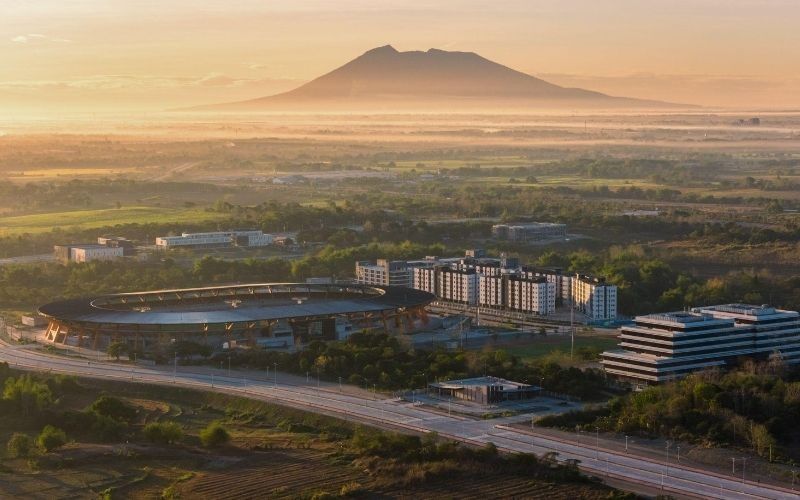
Pax Silica will need a lot of water if the planned New Clark City hub is built at the industrial scale its promoters envision. Semiconductor fabrication repeatedly uses ultrapure water to clean wafers. Data centers can consume substantial water through cooling systems. Mineral processing, wastewater treatment, and the daily operation of a large industrial zone add further demand.
The exact requirement is not public because the final tenant list, facility sizes, cooling systems, recycling targets, and water sources have not been announced. That missing number does not make the concern smaller. It makes a complete public water plan more urgent.
The scale to watch: an independent planning scenario estimates 151 to 303 million liters per day. It is not the government’s final forecast, but it shows the level of demand that planners may need to accommodate if the hub includes several large fabrication plants, hyperscale data centers, and a mineral-processing facility.
A large industrial plan brings a large water requirement
The Philippines and the United States announced a planned 4,000-acre, or roughly 1,618-hectare, industrial hub in New Clark City after the Philippines joined the U.S.-led Pax Silica initiative in April. The project is intended to support artificial intelligence infrastructure, semiconductors, advanced manufacturing, and critical-mineral processing.
Each part of that proposed industrial mix can place pressure on water infrastructure. The U.S. Environmental Protection Agency’s semiconductor study identifies ultrapure-water reject, wafer rinsing, polishing, and cleaning among major fabrication wastewater streams. The U.S. Department of Energy describes cooling-tower systems in data centers as water-intensive applications because water is lost through evaporation and blowdown while heat is removed continuously.
Technology can reduce those demands. Fabs can reclaim process water. Data centers can use less water-intensive cooling. A zone can separate potable, industrial, and recycled-water networks. Those choices must be designed and funded before construction, not promised after pressure appears at household taps.
The available numbers point to a very large requirement
An author-uploaded April paper on ResearchGate constructed a hypothetical “full-scale” zone with three semiconductor fabrication plants, two hyperscale data centers, and one mineral-processing plant. It estimated combined demand at 151 to 303 million liters per day, or MLD.
The scenario is independent research, not an official BCDA forecast or a final tenant plan. It should therefore be read as a planning range rather than a settled project number. Even with that caution, it is useful because it places the possible demand beside New Clark City’s reported water requirements.
20 to 30 MLD
Current New Clark City requirement
BCDA figures reported in February described the city’s present water requirement at this range.
150 to 200 MLD
Expected citywide requirement
Reports on the proposed New Clark City water project placed full-development demand in this range.
151 to 303 MLD
Independent hypothetical scenario
This estimate assumes a facility mix that has not been confirmed as the Pax Silica plan.
The low end of the independent scenario is already close to the expected water requirement of all New Clark City at full development. The high end is greater than the reported 150 to 200 MLD citywide range. If the eventual Pax Silica tenant mix resembles that scenario, one industrial cluster could require water on the scale of an entire planned city.
A technology hub cannot be called future-ready if its water plan is treated as an afterthought.
A lot of water can be managed, but only under strict conditions
BCDA has been working with K-Water and Maynilad on a proposed water and wastewater system for New Clark City. That is an important foundation. It is not yet a Pax Silica water account showing how much each facility would receive, which sources would carry the load, or how the system would perform during drought.
Not every liter of industrial demand must come from treated drinking water. Reclaimed wastewater, closed-loop systems, ultrapure-water recovery, dry or hybrid cooling, and aggressive leak control can reduce pressure on fresh supply. The project should be required to use those tools wherever technically possible.
Using a lot of water does not automatically mean the investment should be rejected. It means water security must be treated as a core project condition, with the same seriousness as roads, electricity, data connections, and national security.
What the government should publish before construction
- A facility-by-facility annual and peak-day water budget, not only a zone-wide estimate.
- The proposed water sources, existing permit allocations, seasonal reliability, and aquifer or watershed impacts.
- Separate targets for potable water, industrial water, recycled water, and discharged wastewater.
- Required technologies for closed-loop reuse, dry or hybrid cooling, leak control, and ultrapure-water recovery.
- Drought triggers that reduce industrial use before households, hospitals, and food production are harmed.
- Independent monitoring with results available to local governments, farmers, communities, and the public.
Francine’s perspective · Opinion
I support progress, but families and farmers should never be asked to carry the water risk.
I want the jobs, skills, and stronger industries that Pax Silica could bring. I also want the water math before the ribbon cutting. Central Luzon grows food, supports communities, and carries the daily needs of millions of people. Water cannot be treated as an invisible input simply because the project sounds advanced.
The companies that benefit should pay for serious recycling, wastewater treatment, efficient cooling, source protection, and independent monitoring. During shortage, homes, hospitals, and food production must not be pushed behind an industrial promise.
Responsible ambition is still ambition. It is simply honest about what progress consumes and disciplined enough to protect the people living beside it.
Sources and methodology
The 151 to 303 MLD range is an independent scenario, not a final government forecast. FMB&CO. uses it as a planning benchmark and identifies it clearly so readers can distinguish a possible high-demand buildout from the still-unpublished official project budget.
Reuters, 17 April 2026: Philippines and U.S. announce planned industrial hubPhilippine News Agency, 20 April 2026: New Clark City to host the planned AI hubPhilippine News Agency, February 2026: New Clark City water proposal and present demandManila Bulletin, 5 February 2026: expected New Clark City water demandIndependent author-uploaded paper, April 2026: hypothetical 151 to 303 MLD scenarioU.S. Environmental Protection Agency: semiconductor manufacturing wastewater studyU.S. Department of Energy: cooling-water use and efficiency in data centersFMB&CO. backgrounder: Pax Silica, without the jargon