
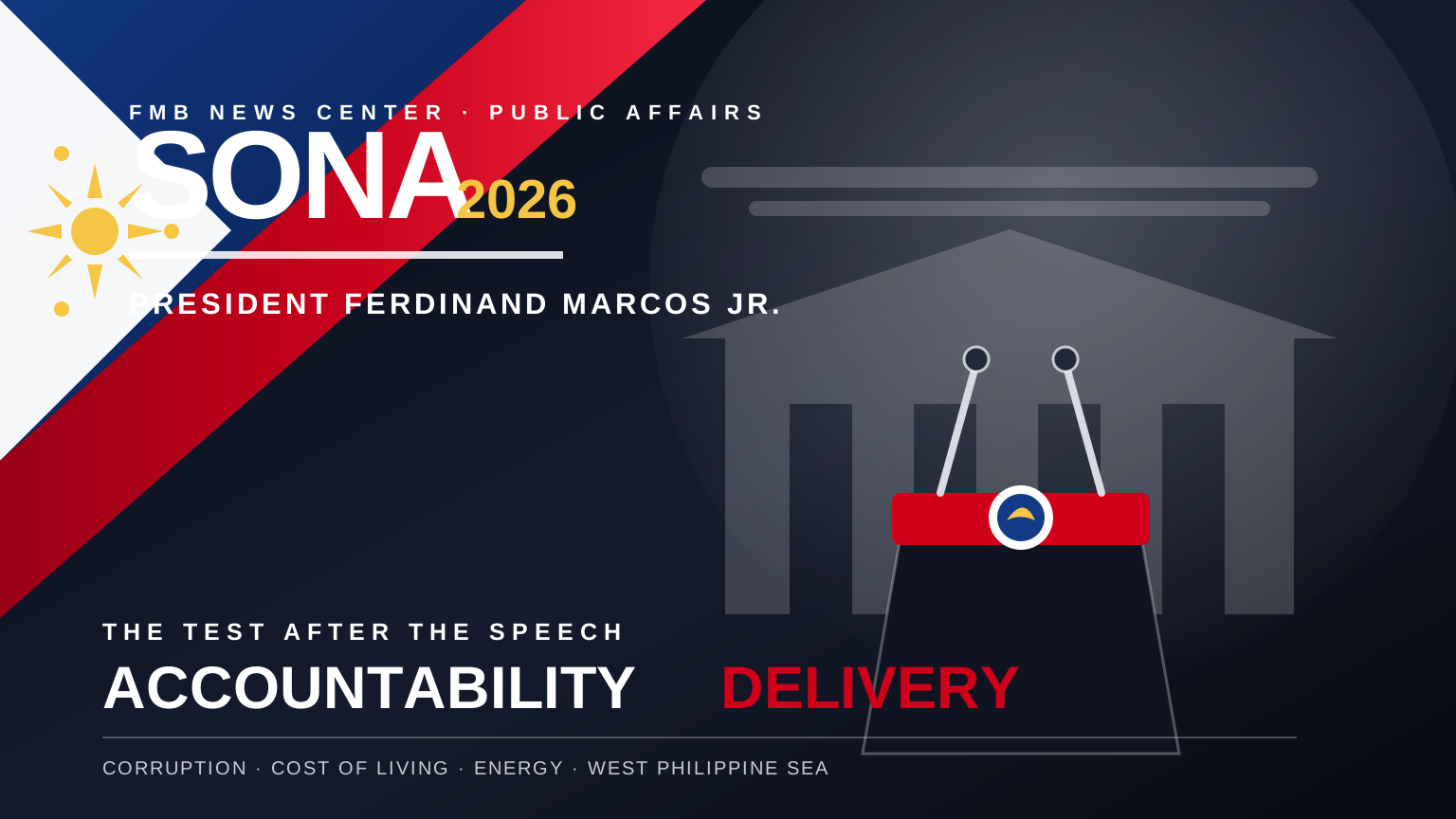
President Ferdinand “Bongbong” Marcos Jr. delivered his fifth and penultimate State of the Nation Address on 27 July 2026 with his administration entering its final two years. The speech covered a wide field, but its most consequential themes were clear: accountability in government, relief from the cost of living, electricity and energy security, and the defense of Philippine rights in the West Philippine Sea.
A SONA is both a report and a promise. It tells the public what the administration believes it has achieved, but it also creates a record against which the government can be measured. For this address, that record now includes unusually direct commitments involving political allies, consumer electricity charges and the country’s sovereign position.
The main test: the address created expectations that corruption cases will move, electricity reform will reach household bills, economic relief will reach ordinary workers and small businesses, and the government will defend Philippine rights through lawful and peaceful action.
Accountability became the defining political message
The strongest section of the address concerned the continuing investigation into alleged irregularities in flood-control projects. Marcos said cases could soon be filed against former House Speaker Martin Romualdez, his cousin and a former central political ally. Romualdez has denied wrongdoing and said he is prepared to answer any charges.
The political weight of the statement came from the President’s insistence that family and friendship should not determine who is protected. That declaration matters, but the credibility of the anti-corruption campaign will depend on what follows: independent investigation, evidence-based prosecution, equal treatment, asset recovery and institutional reforms that make the same abuses harder to repeat.
The public should not be asked to treat an announced case as a conviction. Due process remains essential. At the same time, political influence should not become a shield against investigation. The standard must be the same in both directions.
Accountability becomes real only when the law reaches power without abandoning evidence, fairness and due process.
Economic relief must be felt beyond the speech
Marcos asked Congress to consider tax-relief measures, including broader income-tax exemptions for workers and the removal of the minimum corporate income tax for small businesses. The House later said it was prepared to work on proposals involving workers earning up to ₱350,000 annually, other income-tax reductions, small-business relief and tax amnesty measures.
These proposals may help, but their value will depend on the final legislation, eligibility rules and fiscal design. Tax relief should not become a headline that mainly benefits people already securely inside the formal economy while informal workers, contractual employees and low-income families continue to absorb high food, transport, rent, medicine and utility costs.
For small businesses, a lower tax burden is only one part of survival. Entrepreneurs also need simpler permits, access to financing, reliable internet, predictable electricity, affordable logistics and customers with enough purchasing power to keep local commerce moving.
Electricity reform drew one of the clearest consumer promises
The President urged Congress to amend the Electric Power Industry Reform Act so that system-loss charges would no longer be passed to consumers, including the value-added tax imposed on those charges. System loss refers to electricity that enters the distribution system but is not ultimately billed as delivered consumption because of technical and non-technical losses.
The principle is easy to understand: households should not automatically carry the cost of inefficiency, infrastructure losses, metering problems or electricity theft that they did not cause. The legal and regulatory design, however, must prevent the same costs from quietly returning through another billing line, higher distribution charges or weaker investment in the grid.
A serious amendment should identify which losses utilities must absorb, which investments are required to reduce them, how regulators will verify compliance and how consumers can see the effect in actual monthly bills.
Nuclear energy requires more than a promise of safety
Marcos also said the country should reconsider nuclear energy as part of a broader response to energy insecurity and high fuel prices. The proposal deserves neither automatic rejection nor automatic celebration. Nuclear power is a long-term infrastructure, financing, regulatory and public-trust decision.
Any nuclear program must publish transparent cost comparisons, technology choices, construction and decommissioning plans, waste-management arrangements, emergency procedures, insurance and liability rules, independent regulatory safeguards and the effect on electricity prices. Public consultation cannot be reduced to a campaign explaining only the benefits.
The policy discussion should also distinguish between developing newer nuclear technologies and attempting to revive the Bataan Nuclear Power Plant. These are related debates, but they are not the same project and should not be presented as though one automatically requires the other.
The West Philippine Sea remains a test of consistent state policy
On foreign policy, the President reaffirmed the importance of the 2016 arbitral ruling and said the government would continue to uphold it through peaceful and lawful means. The ruling remains central to the Philippines’ legal position in the South China Sea, even as China continues to reject it.
The West Philippine Sea is not only a diplomatic symbol. It concerns sovereignty, maritime rights, fisheries, food security, environmental protection and the safety and livelihood of Filipino fisherfolk. A credible policy therefore requires more than strong language. It requires sustained maritime capability, diplomacy, international partnerships, scientific monitoring and direct support for communities that depend on the sea.
The next SONA should answer measurable questions
The 2026 address gave the administration a possible final-act narrative: pursue accountability even when politically painful, reduce burdens on households and small businesses, reform electricity policy, confront energy insecurity and remain firm on national rights.
That narrative will succeed only if the public can see evidence before the next address. The government should publish timelines, legislative progress, case status, recovered assets, regulatory changes and consumer outcomes in forms ordinary citizens can understand.
Accountability
Did the cases move?
Were investigations independent, charges evidence-based and public funds recovered?
Household relief
Did bills and costs fall?
Did tax and electricity reforms create visible relief for workers and families?
National interest
Were rights protected?
Were fisherfolk, maritime personnel and Philippine legal claims supported consistently?
Francine’s perspective · Opinion
A SONA should be treated as a public contract, not a one-night performance.
The speech was strongest when it acknowledged that accountability may be politically painful. But the public has heard strong declarations before. What restores trust is not the force of a line. It is the visible consequence that follows it.
Filipinos should be able to trace each major promise from the podium to a bill, a budget, a case, a regulation, a completed program or a lower household expense. That is how a national address becomes more than ceremony.
The final two years will not be judged by applause inside Congress. They will be judged by whether people outside the chamber experience a government that is fairer, less wasteful, more protective and more honest about what it has and has not delivered.
Sources and publication note
This analysis was prepared on the evening of 27 July 2026 using official releases and independently reported accounts available after the SONA. FMB News Center will update the source record if the complete official transcript adds material context or corrects any detail.
Reuters, 27 July 2026: anti-corruption, tax relief and the 2016 arbitral rulingAssociated Press, 27 July 2026: corruption cases, West Philippine Sea and nuclear-energy remarksPhilippine News Agency, 27 July 2026: overview of the fifth SONA and final-term prioritiesPhilippine News Agency, 27 July 2026: proposed EPIRA amendment and system-loss chargesHouse of Representatives, 27 July 2026: legislative response and tax-relief proposalsPresidential Communications Office, 10 July 2026: government position on the 2016 arbitral award